
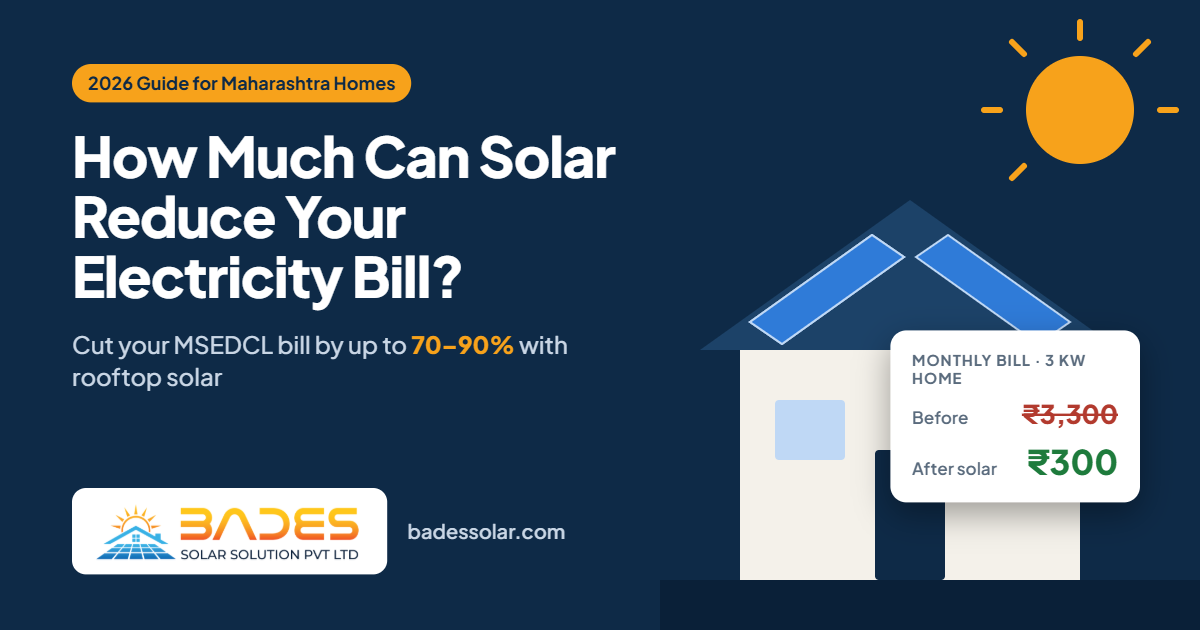
A correctly sized rooftop solar system can reduce your electricity bill by 70% to 90%. In Maharashtra, each 1 kW of solar produces about 120 units a month. So a home using 350 units a month can bring a ₹3,000+ bill down to a few hundred rupees with a 3 kW system. Solar cannot remove fixed charges and some taxes, which is why the bill rarely becomes zero.
Key facts at a glance
• 1 kW of solar = about 4 units a day, or 120 units a month
• Savings: 70–90% of the bill for a correctly sized system
• What stays on the bill: fixed charges, meter rent and some taxes
• Payback for a 3 kW home system with subsidy: about 3–4 years
• Panel life: 25+ years, so you get roughly 20 years of near-free electricity
Every month, the MSEDCL bill seems to go up. Summers mean AC and coolers, and the higher your usage, the higher your per-unit rate. That is the main reason families in Chhatrapati Sambhajinagar and across Marathwada are asking one simple question: if I install solar, how much will my bill actually come down?
This guide answers that in plain numbers. You will see how solar reduces the bill, how much power a system makes in our region, real savings examples by bill size, and what solar cannot remove. By the end, you will know roughly what your own bill could look like after solar.
How does solar reduce your electricity bill?
Solar reduces your bill by cutting the number of units you buy from MSEDCL. It works in three simple ways.
- Daytime use is free: During the day, your fans, fridge, TV and motor run on solar power first. You don’t pay for these units.
- Extra power goes to the grid: When panels make more than you use, the extra goes to MSEDCL through a net meter. These units are credited to you.
- Night use is adjusted: At night you use grid power as usual. At the end of the month, MSEDCL subtracts your exported units from your imported units. You pay only for the difference.
Simple example: You use 350 units in a month. Your solar system exports 200 units and you use 160 units directly in the day. MSEDCL bills you for only 350 − 160 − 200 = −10 units, which means zero energy charges and 10 units carried forward.
There is a second hidden saving. MSEDCL charges a higher rate per unit as usage goes up. When solar brings your usage down, you also drop to the cheaper slab. So your savings per unit are often higher than the average rate on your bill.
Want the full process? Read our step-by-step guide on how to apply for net metering in Chh Sambhajinagar.
How much electricity does a solar system make in Marathwada?
In Chhatrapati Sambhajinagar and the rest of Marathwada, 1 kW of solar produces about 4 to 4.5 units a day, or roughly 1,400 to 1,500 units a year. That is about 120 units a month on average. Industry guides put a 1 kW system at around 1,440 units a year, which matches what we see on our own installations.
Generation is highest from February to May, when skies are clear. It drops during the monsoon (June to September) but does not stop. Good months make up for the weak ones, so your yearly savings stay steady.
How much will your bill come down? Savings by bill size
The bigger your bill, the more solar saves, because you also escape the costliest slabs. The table below shows typical results for MSEDCL home connections.
- 120 units a month (bill about ₹1,000): a 1 kW system brings the bill down to ₹200–300. You save ₹700–800 a month, or ₹8,400–9,600 a year.
- 250 units a month (bill about ₹2,200): a 2 kW system brings it down to ₹250–350. You save ₹1,850–1,950 a month, or ₹22,000–23,000 a year.
- 350 units a month (bill about ₹3,300): a 3 kW system brings it down to ₹250–400. You save ₹2,900–3,050 a month, or ₹35,000–36,500 a year.
- 600 units a month (bill about ₹6,500): a 5 kW system brings it down to ₹300–500. You save ₹6,000–6,200 a month, or ₹72,000–74,000 a year.
- 1,200 units a month (bill about ₹13,500): a 10 kW system brings it down to ₹500–800. You save ₹12,700–13,000 a month, or over ₹1.5 lakh a year.
Estimates only. They assume an effective cost of about ₹8.5 to ₹11 per unit after wheeling charges, fuel adjustment charge (FAC) and electricity duty, based on MSEDCL’s FY 2026–27 slab rates. Your actual bill depends on your slab, sanctioned load and how much power you use in the day.
How to find your own number: check the “units consumed” on your last 12 MSEDCL bills, take the average, and divide by 120. That is roughly the system size in kW you need. For example, 360 units ÷ 120 = 3 kW.
What solar cannot remove from your bill
Solar removes the energy charges, which is the biggest part of the bill. But a few charges stay, even when you produce more than you use.
- Fixed charges: a monthly charge for having an MSEDCL connection. For homes, it is around ₹150 a month in FY 2026–27.
- Meter rent and small fees: charged per connection, not per unit.
- Part of the taxes: electricity duty on the units you still import.
This is why most solar homes still get a small bill of ₹200 to ₹500. Be careful of anyone who promises a zero bill. A good installer will tell you the honest number up front.
What affects how much you save?
Two homes with the same system can see different savings. These six things make the difference.
- System size: an undersized system leaves part of the bill unpaid. Many families take only 3 kW to get the maximum subsidy, even when they need 4–5 kW.
- Shadow-free roof: shade from a water tank, tree or nearby building can cut output by 10–30%.
- Panel direction and tilt: in Maharashtra, panels facing south at about 15–20° give the best output.
- Panel and inverter quality: good brands lose less power over the years. See our guide on DCR vs Non-DCR solar panels.
- Cleaning: dust is common in Marathwada. Dirty panels can produce noticeably less power.
- Your tariff slab: homes in higher slabs save more per unit because solar pushes them into cheaper slabs.
Cost, subsidy and payback: when does solar pay for itself?
Most home solar systems in Maharashtra pay for themselves in 3 to 5 years. After that, you get free electricity for the remaining 20+ years of panel life.
Under the PM Surya Ghar Muft Bijli Yojana, homes get a central subsidy of ₹30,000 per kW for the first 2 kW and ₹18,000 for the 3rd kW, up to a maximum of ₹78,000.
- 2 kW system: costs about ₹1.2–1.4 lakh. After the ₹60,000 subsidy, you pay ₹60,000–80,000. It saves about ₹22,000 a year and pays back in about 3–3.5 years.
- 3 kW system: costs about ₹1.7–2.1 lakh. After the ₹78,000 subsidy, you pay ₹92,000–1.32 lakh. It saves about ₹36,000 a year and pays back in about 3–4 years.
- 5 kW system: costs about ₹2.8–3.4 lakh. After the ₹78,000 subsidy, you pay ₹2.02–2.62 lakh. It saves about ₹73,000 a year and pays back in about 3–3.5 years.
Price ranges based on 2026 India market rates. Actual prices depend on brand, structure height and roof type.
Not sure if you qualify for the subsidy? Read our PM Surya Ghar Yojana subsidy guide for Chh Sambhajinagar. Solar loans and EMIs are also available, and in many cases the EMI is close to what you were paying in bills.
6 tips to save even more with solar
- Size for your real usage, not just the subsidy. Use your 12-month average units, and plan for a new AC or EV.
- Run heavy appliances in the daytime. Washing machine, water pump, iron and geyser between 10 am and 4 pm use free solar power directly.
- Clean panels every 2–4 weeks. Use plain water and a soft cloth, early morning or evening.
- Check your app weekly. Most inverters have a mobile app. A sudden drop in units means something needs attention.
- Read your net meter bill. Make sure export units are being credited correctly.
- Choose a registered vendor. A proper installer handles subsidy, net metering and service. Here’s how to verify an MNRE-registered vendor.
Frequently asked questions
Can solar make my electricity bill zero?
Almost, but not fully. Solar can remove the energy charges, but fixed charges, meter rent and some taxes remain. Most solar homes pay ₹200 to ₹500 a month.
How much does a 3 kW solar system save per month?
A 3 kW system makes about 360 units a month in Maharashtra. For a home using around 350 units, that saves roughly ₹2,900 to ₹3,000 a month, or about ₹35,000 a year.
How many units does 1 kW of solar produce?
About 4 to 4.5 units a day in Marathwada, which is around 120 units a month and 1,440 units a year.
Should the vendor keep my portal login?
The vendor may assist, but the consumer should retain control of the registered mobile number, understand OTP actions and keep copies of all submissions.
What should I verify before paying an advance?
Verify the portal listing, legal entity, bank beneficiary, exact products, complete EPC scope, payment milestones, warranty terms and cancellation conditions.
Find out exactly how much you can save
Every home is different, and the only way to know your real savings is a proper site check. Bades Solar offers a free site survey across Chhatrapati Sambhajinagar and Marathwada, including Jalna, Beed, Latur, Parbhani, Nanded and Hingoli. Our engineers will check your roof, study your last 12 bills and give you a clear savings estimate, with subsidy and net metering handled for you.
- Call / WhatsApp: +91 80800 68383
- Email: sales@badessolar.com
- Book your free site survey