
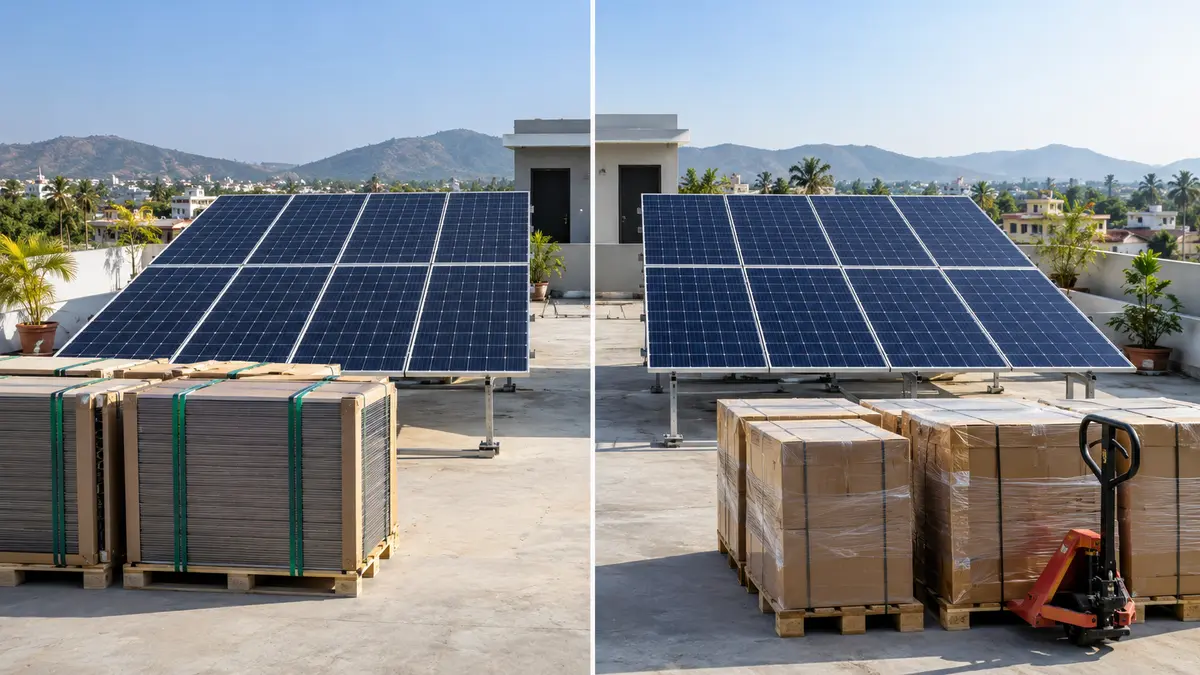
DCR vs Non-DCR Solar Panels: What Is the Difference and Which Should You Choose?
Home > Blog
DCR and Non-DCR are policy and sourcing classifications, not grades such as premium and ordinary. The distinction becomes important when a residential customer wants central financial assistance under PM Surya Ghar or when a project is governed by another scheme with domestic-content requirements.
A buyer should therefore avoid choosing modules only from a price list. The correct decision depends on project type, subsidy intent, applicable rules, module model, warranty, efficiency, temperature performance, EPC design and long-term support.
What Does DCR Mean in Solar Panels?
DCR stands for Domestic Content Requirement. For schemes where DCR applies, the relevant solar cells and modules must meet the prescribed domestic-manufacturing conditions in India. The vendor must be able to provide the required traceability and certificates for the installed modules.
For an eligible PM Surya Ghar residential installation claiming central financial assistance, DCR-compliant modules are required under the current scheme framework. The DCR Verification Portal developed by NISE supports traceability of domestically manufactured cells and modules used in government-supported schemes.
What Are Non-DCR Solar Panels?
Non-DCR modules do not meet the domestic-content condition required by the relevant subsidised scheme. They may be imported modules or modules assembled in India using imported cells. Non-DCR does not automatically mean poor quality, and DCR does not automatically prove superior generation.
A private project that is not claiming applicable central assistance may have greater flexibility, subject to current laws, technical approvals, procurement rules and the project’s contract. A homeowner should decide only after confirming whether the subsidy remains part of the financial plan.
DCR vs Non-DCR: Key Differences
Manufacturing requirement
DCR focuses on prescribed domestic origin for the cells and modules. Non-DCR modules fall outside that requirement, even when final assembly occurs in India.
Subsidy eligibility
DCR compliance is material for PM Surya Ghar installations claiming central financial assistance. Installing non-DCR modules can make an otherwise eligible residential project non-compliant for subsidy.
Documentation and traceability
DCR projects require supporting documentation and portal-aligned module records. Buyers should ask for the precise manufacturer, model, serial numbers, invoice description and DCR certificate process instead of accepting a verbal assurance.
Product choice and price
Non-DCR procurement can sometimes offer broader sourcing or a different price point. However, market prices change and should not be presented as a fixed per-watt difference. Compare the net project cost after subsidy eligibility, not merely the module price.
Performance
Energy generation depends on module technology, efficiency, degradation, temperature coefficient, shade, orientation, inverter matching and installation quality. DCR status alone does not establish how much electricity a panel will produce.
DCR, ALMM and BIS Are Not the Same Thing
These terms are often mixed together in sales discussions. DCR addresses domestic-content compliance. ALMM is the Approved List of Models and Manufacturers maintained by MNRE for applicable projects. BIS registration relates to conformity with specified Indian standards for covered products. One label should not be used as proof of all three.
Before purchase, verify the exact module model rather than only the brand name. A manufacturer may have multiple models, and applicability can change as official lists are updated. Consult the current MNRE ALMM information and scheme documentation at the time of installation.
Which Panels Should a Homeowner Choose?
Choose DCR-compliant panels when:
- You are eligible for and intend to claim PM Surya Ghar central financial assistance
- The approved project or financing condition expressly requires DCR modules
- The selected vendor can provide traceable, scheme-compliant documentation
- The exact module model also satisfies other applicable technical requirements
Consider Non-DCR panels only when:
- You have consciously decided not to claim the applicable subsidy
- The project is privately funded and current rules permit the selected equipment
- The EPC provider has compared lifecycle value, warranties and technical performance
- The absence of subsidy has been included in the financial comparison
For many eligible residential customers, DCR is the practical choice because retaining subsidy eligibility can matter more than a lower upfront module price. For a non-subsidised project, the comparison should focus on delivered generation, reliability, warranty enforceability and total EPC value.
Questions to Ask Before Signing a Quotation
- Is the quotation designed for a subsidy-linked or non-subsidised project?
- What is the exact module manufacturer, model and wattage?
- Are both the cells and modules compliant with the applicable DCR requirement?
- How will DCR traceability and certificate details be recorded?
- Is the exact model present on the current applicable ALMM list?
- What product and performance warranties apply, and who honours them?
- Does the invoice clearly identify the installed equipment?
- Will the same equipment appear in the portal, inspection and commissioning records?
Common Misunderstandings
“Made in India” always means DCR
Not necessarily. A module assembled domestically may still use imported cells. Ask for scheme-specific DCR evidence.
DCR panels always generate more
DCR is not an efficiency rating. Compare technical datasheets and site design.
Any Indian brand qualifies for subsidy
Eligibility depends on the applicable rules, exact products, project records and installation process, not the nationality of the brand alone.
ALMM and DCR are interchangeable
They address different compliance questions. Verify both where the project requires them.
How This Decision Fits into a Residential Solar Project
Panel selection should happen after electricity-bill analysis, roof inspection and system sizing. Read how many panels a 3 kW solar system may require, then compare actual module dimensions and layout. If subsidy is part of the plan, review our PM Surya Ghar guide before finalising the quotation.
Bades Solar provides on-grid residential solar solutions and supports eligible homeowners with system design, equipment selection, installation and applicable documentation. A local site survey by a solar company in Chh Sambhajinagar can identify whether the proposed panel choice fits the roof, inverter and financial objective.
Frequently Asked Questions
DCR modules meet the domestic-content requirement prescribed for relevant government-supported projects. Non-DCR modules do not meet that specific condition.
Under the current framework, subsidy-linked installations require DCR-compliant modules. Verify the live scheme requirements before purchase.
They may be used in projects not claiming applicable central assistance when current regulations and technical requirements permit. Obtain project-specific confirmation before procurement.
No. Quality depends on the exact product, certifications, manufacturing controls, warranties and system design. DCR identifies domestic-content compliance.
Ask for the exact model, serial numbers, invoice and DCR documentation, and confirm that the vendor records them through the prescribed verification process.
Conclusion
The DCR vs Non-DCR decision should begin with one question: are you claiming subsidy under a scheme that requires domestic content? If yes, DCR compliance is essential. If no, compare permitted products using technical performance, warranty, total project cost and long-term service rather than labels alone.


1 Comment
[…] are also encouraged to understand the difference between DCR and Non-DCR solar panels, particularly where subsidy eligibility is concerned, since this classification often decides […]